Mistral Large 4, decoded: what three more weeks of reinforcement learning actually bought
On 29 October, Mistral released the open weights of Large 4, and says the model improved sharply in the three weeks after its preview. The interesting part isn't the trillion parameters. It's how a model keeps getting better after its main training run, and how to read the numbers that say so.
Swipe the carousel on Instagram ↗What happened
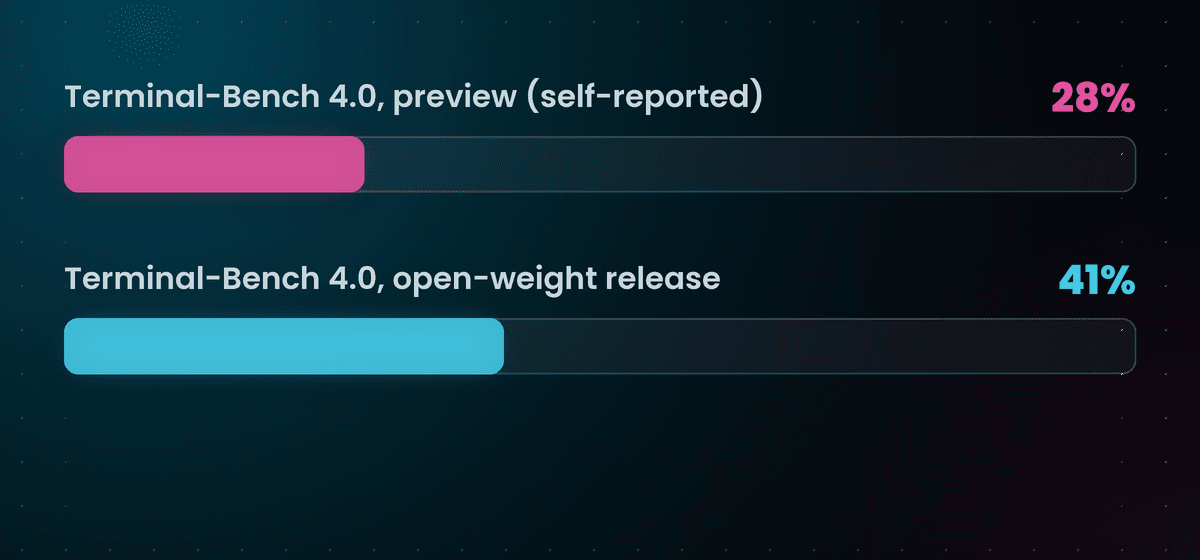
Mistral launched Mistral Large 4 (nicknamed Le Chonk) as a public preview on 6 October 2026, then published the open weights on Hugging Face on 29 October. In between, it kept training. Mistral says "just three weeks of additional reinforcement learning" moved the model to the front of open-weight coding benchmarks, with the headline result being Terminal-Bench 4.0 rising 13 percentage points to 41%.
The basics, from Mistral's documentation and the model card:
- 1.05 trillion total parameters (usually rounded to 1T)
- 52 billion active per token, or 49 billion if you leave out the embedding and output layers
- A 1-million-token context window
- Takes text and images in, writes text out
- Trained from scratch on 3,800 NVIDIA Grace Blackwell GPUs in Mistral's European datacenters
- API price of $0.70 input, $0.07 cached input and $2.10 output per million tokens
Like Meta's Muse Spark Open, it's a mixture-of-experts model, where only a fraction of the parameters run on each token. We covered that idea in our Muse Spark Open breakdown, so here we'll focus on something newer: the training that happens after the model already exists.
A trained model isn't a finished model
When people say an AI model was "trained", they usually picture one giant run. In practice, labs work in stages. The first builds the base model. What follows is called post-training, and Mistral describes two stages of it for Large 4: supervised fine-tuning and reinforcement learning.
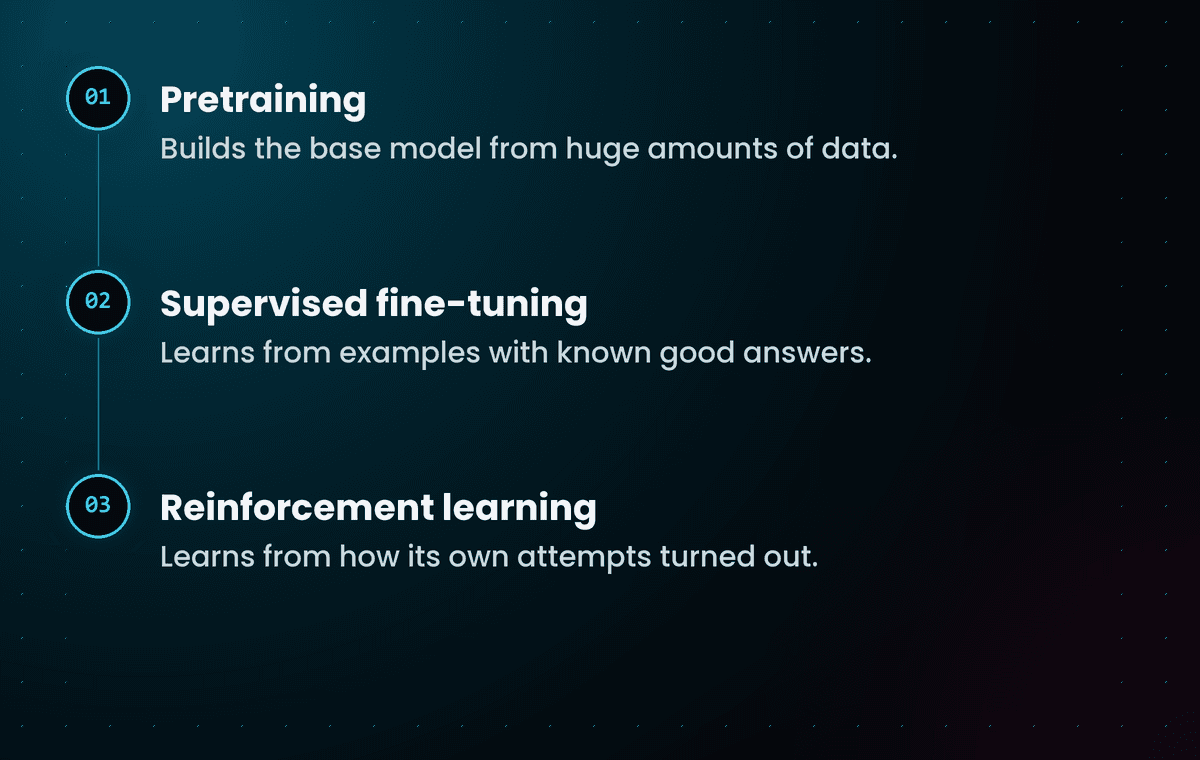
The difference comes down to where the feedback comes from. Supervised fine-tuning shows the model examples with good answers attached. Reinforcement learning (RL) has no answer sheet: the model tries a task, the outcome is scored, and training favours whatever led to better results.
Mistral's argument for RL is that fixed examples stop being useful. As it puts it, samples that once pushed a model to its limits won't any more. With RL, it can raise the difficulty and breadth of the tasks as the model gets stronger.
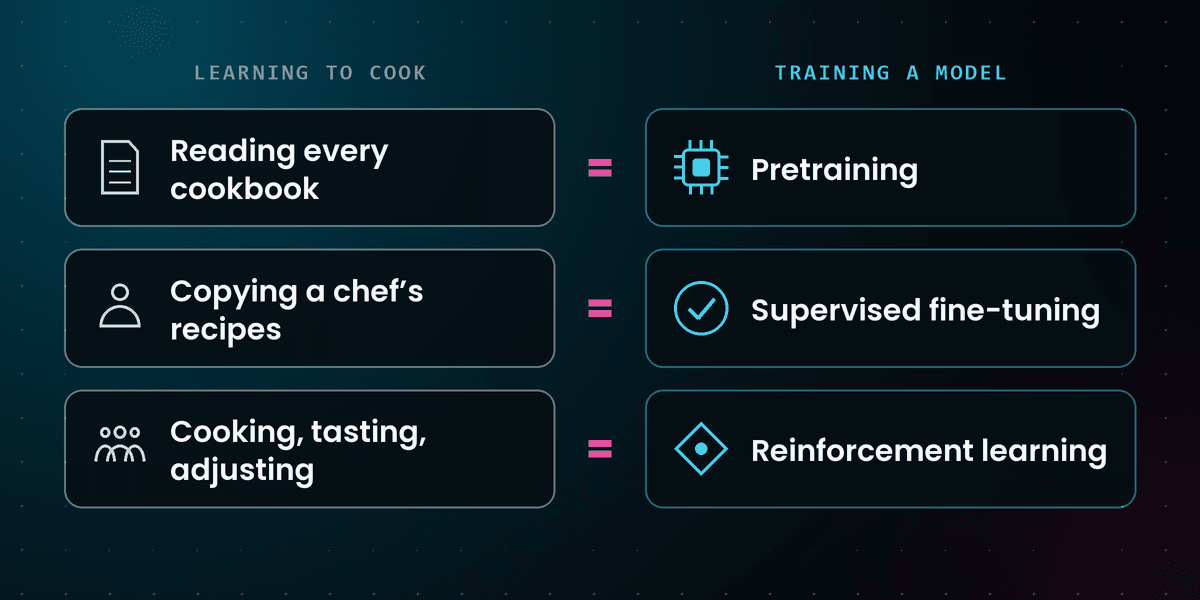
How Mistral's practice loop works
Mistral's preview post gives a rare look at the setup. A single training run can mix very different tasks, from one-turn chat to hard science problems, safety, factuality and long tool-using jobs. The tasks share resources such as code sandboxes, web search and external APIs.
Each attempt then needs a score, and Mistral combines several kinds of checker depending on the task: reward models, unit tests, LLM judges and static checks.
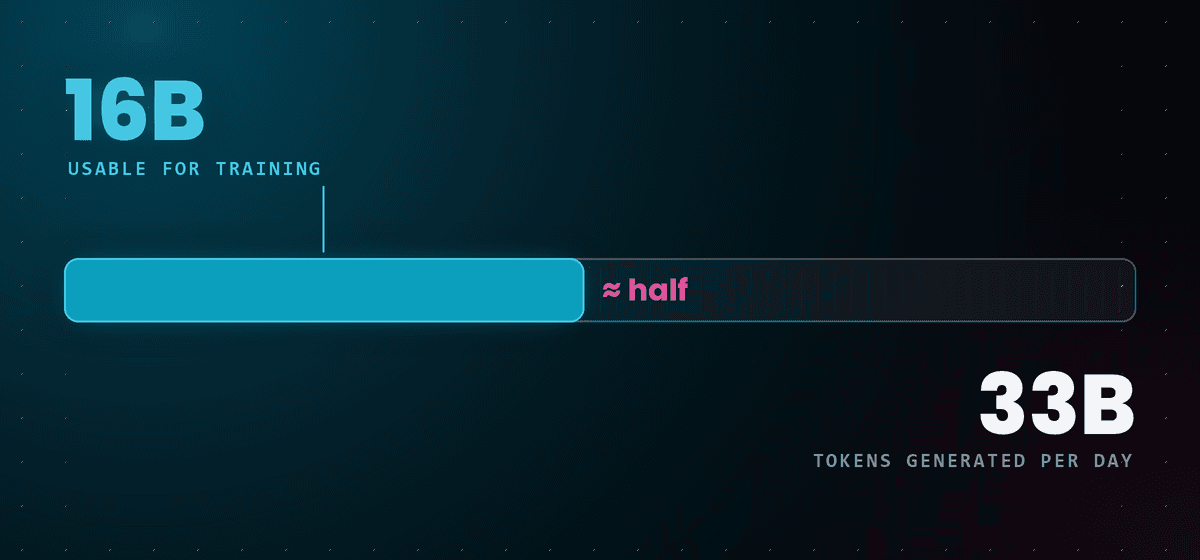
The scale is striking. At around 3,000 GPUs, Mistral says one run produces roughly 33 billion tokens a day, of which about 16 billion are usable as training data after filtering and masking. A fleet of workers generates tens of thousands of attempts in parallel, while training carries on asynchronously.
Going deeper: why long agent tasks are hard to train on
Mistral says its pipeline is built for long attempts, with budgets of millions of tokens across multiple compactions (shortening the conversation so far so the work can continue). It also describes keeping "staleness" low and minimising "off-policy drift".
What the extra three weeks changed
| Measure | Preview | Open-weight release |
|---|---|---|
| Terminal-Bench 4.0 | 28.3% (self-reported) | 41% |
| Finance work (Finch) | 67.4% | 73.3% |
| Attacks resisted (Lakera B3) | 93.3% | 97.1% |
| Refusals of harmful cyber prompts | About 95% | 96.6% |
| Coding Agent Index | 49.8% | 48% |
Mistral also reports 30% fewer output tokens on Terminal-Bench, and a separate climb on the BrowseComp web-browsing test from 75% on an early fine-tuning checkpoint to 84.5%. It also says "no signs of saturation", meaning it expects more gains from more training. That's a forecast from the company selling the model, so treat it as one.
Why tokens per task matters more than you'd think
The most useful number for builders may not be a score at all. On the Artificial Analysis Coding Agent Index, Mistral says Large 4 scored 48%, effectively tied with the leading open model GLM-5.3, while using 47% fewer tokens per task on average.
Agents loop: read, think, call a tool, read the result, think again. Every pass costs tokens, so a model that wanders costs more than its price per token suggests. To control that trade-off, Large 4 has three reasoning modes: low for simple tasks, medium for everyday work and high for the hardest jobs. High is the default.
Read the scoreboard carefully
"13 points in three weeks" is a great headline. Before you repeat it, a few things are worth knowing:
- The comparison may not be like for like. Mistral labels the 28% preview score as self-reported, while the 41% appears on a chart titled for Artificial Analysis. Different test runs can give different results.
- Not every number went up. The Coding Agent Index was 49.8% in the preview post and 48% in the release post. Mistral doesn't explain the difference, and the two may not be comparable, but it's a reminder that gains aren't uniform.
- The credit is hard to split. Mistral also says it acted on feedback from the preview, so RL may not be the only cause.
- It isn't the top open model on everything. The model card scores it 26 on the Artificial Analysis Intelligence Index v5, the highest among Western open-weight models, and says leading open models from China score higher.
- It isn't the top model overall. In Surge Code's blind human comparisons, Mistral says it beat the open models tested but ranked behind Claude Opus 5.5.
- Some benchmarks can't be checked. FrontierCode 2.0, where it leads at 19.7%, is a private benchmark.
What you can actually do with it
- Try it hosted. It's available through Mistral Studio, the Mistral API, OpenRouter, NVIDIA-hosted endpoints and Microsoft Foundry. The API name is
mistral-large-4. - Run it locally, with serious hardware. Hugging Face says the 2-bit quantised builds run on a single Apple Silicon Ultra with 512 GB of unified memory, while other builds need distributed inference. Its test of the Q2_K build on an M3 Ultra reached about 15 tokens a second, so it's usable rather than quick.
- Serve it properly. Mistral recommends vLLM or SGLang. Hugging Face's endpoint recipe runs the FP8 weights on 8 H200 GPUs. The repo is about 1 TB.
- Fine-tune it. Hugging Face shows fine-tuning with TRL on a node of 8 B300s. The model card also lists Axolotl and Unsloth.
- Borrow the idea. You don't need 3,000 GPUs to use the core lesson. If your task has a checkable outcome, like tests that pass or an exploit that stops working, you have a reward signal. Hugging Face suggests exactly this for security work: use traces from patching your own code base to fine-tune smaller models.
Limitations worth knowing
- The hardware bar is high. The smallest setup Hugging Face describes is a 512 GB machine running a 2-bit build, so this isn't a laptop model.
- Long context is slow locally. In Hugging Face's llama.cpp tests at 800K context, generation fell to about 3 tokens a second at long lengths.
- Reasoning can't be switched off. Hugging Face notes this, and the low mode replaces the old "None" option.
- Cyber guardrails are still moving. Mistral says the model refused black-box attacks on live targets, but that it sees potential for uplift to real attacks and is changing its guardrails.
- Local results may differ. The model card suggests trying Mistral's API if a self-hosted setup performs poorly.
The licence, in plain English
Large 4 ships under the Mistral Ecosystem Open-Weight License, a modified MIT licence. You can use, modify, fine-tune and sell products built on it. Keep the copyright notice, and watch for one big exception:
- If you or an affiliate operate a Model as a Service business, you need a separate commercial licence from Mistral before commercial use.
- That means letting third parties use the model or its derivatives, for example through an API, with meaningful control over inputs, parameters or training data.
- End-user products with the model embedded in specific features, relaying requests to models hosted by others, and purely internal use are excluded.
The takeaways
- Models keep improving after their main training run. Post-training, especially reinforcement learning, is now a major part of the work.
- RL trains on the outcomes of a model's own attempts, so anything with a checkable result can become a training signal.
- A benchmark score belongs to one build at one moment. Ask which version was tested, and by whom.
- For agents, compare tokens per task as well as price per token. That's closer to what you'll actually pay.
- Large 4 is a strong open option for coding, but nearly all of today's numbers are Mistral's. Test it on your own work.
Sources
- Mistral Large 4 (Le Chonk) is now open weight (Mistral)Primary source
- Introducing Mistral Large 4 (Mistral)Primary source
- Mistral Large 4 model card (Mistral, on Hugging Face)Primary source
- Mistral Ecosystem Open-Weight LicensePrimary source
- Mistral Large 4 documentationReference
- Welcome Le Chonk: Mistral Large 4 on Hugging FaceTechnical deep dive